

Understanding Binary Coded Decimal Basics
Explore Binary Coded Decimal (BCD) 📊 — understand its basics, types, comparison with other systems, practical uses in digital tech, and common challenges.
Edited By
Lucas Bennett
Binary Coded Decimal (BCD) is a way of representing decimal numbers so that each digit retains its own binary equivalent. Unlike regular binary numbers where the entire figure is converted directly, BCD breaks down every decimal digit (0 to 9) into a four-bit binary number.
For example, the decimal number 59 in BCD form is represented as 0101 (for 5) and 1001 (for 9), instead of the standard binary 111011. This method is particularly useful in digital systems where precise decimal handling is needed, such as calculators, digital clocks, and financial devices.

In Nigerian fintech and electronic banking, BCD plays a quiet but steady role. When you send money using platforms like GTBank's mobile app or OPay, the system uses underlying digital logic that handles decimal amounts carefully to avoid rounding errors common in pure binary arithmetic. BCD ensures each digit stays exact, which helps in shown transactions, currency calculations, and report generation.
Each decimal digit uses exactly 4 bits
Only binary values 0000 to 1001 (0–9) are valid in each digit’s place; 1010 to 1111 are invalid and typically unused
Simplifies conversion back to human-readable decimal numbers, making readouts more intuitive
Think of BCD like a danfo driver counting passengers using fingers rather than estimating total by weight. Each finger represents one exact unit, so there’s no risk of guessing wrong. Similarly, BCD keeps the decimals exact, avoiding confusion in financial records or measurement devices.
BCD offers a neat balance between digital binary and human-friendly decimal systems, making it an asset in many Nigerian electronics where currency precision is non-negotiable.
Understanding BCD can be your first step if you are looking to grasp how computers interact with decimals or want to improve your knowledge of digital tech within Nigeria’s growing digital economy.
Understanding Binary Coded Decimal (BCD) is key for those involved in finance, trading, or technology, especially as digital systems increasingly intersect with local markets. At its core, BCD represents each decimal digit (0 to 9) using a fixed group of binary bits. This method ensures decimal numbers maintain their exact form in binary systems without approximation errors common with pure binary equivalents.
BCD is a way to express decimal numbers so that each individual digit is encoded separately into binary form. Unlike typical binary numbers, which convert the entire decimal value into one binary stream, BCD handles each decimal place distinctly — for example, the decimal number 45 becomes 0100 0101 in BCD (4 as 0100 and 5 as 0101). This simplifies operations in devices like calculators and digital clocks where digits are manipulated one at a time.
The beauty of BCD lies in its straightforwardness: every decimal digit remains visible in binary, making it easier for programmers and electronic devices to process decimal numbers without losing their human-readable structure. This approach is particularly useful when dealing with monetary values in naira, where precision in decimal digits is non-negotiable.
BCD allows digital devices to handle decimal numbers conveniently by encoding each digit in 4 bits, preserving accuracy and human readability.
Regular binary converts a whole number into a continuous sequence of bits. For example, decimal 45 in pure binary is 101101, which represents 45 as a whole in base-2. However, this method can lead to rounding issues or complexity when trying to display digits individually or perform decimal-based arithmetic.
BCD avoids this by encoding each decimal digit separately:
In BCD, digits 0–9 have a unique four-bit binary equivalent.
Numbers like 45 store ‘4’ as 0100 and ‘5’ as 0101, keeping them distinct.
Pure binary treats the number as a single value, losing the discrete digit separation.
This distinction matters for systems requiring precision and clarity with decimal digits, such as banking software managing ₦1,234,567.89 or POS terminals calculating change. Regular binary might represent numbers more efficiently but complicates digit-wise operations and increases the risk of errors in decimal rounding.
In summary, BCD balances computer-level efficiency with human-friendly decimal handling, making it essential for sectors like finance and embedded systems in Nigeria, where accurate decimal representation matters.
This section sets the foundation to explore how BCD operates and its practical usage, grounding your understanding in why this method matters beyond just theory.
Understanding how Binary Coded Decimal (BCD) operates is key to grasping its role in digital systems, especially in finance, trading, and electronic devices. BCD works by encoding each decimal digit individually into its binary equivalent, rather than converting a whole number into a binary form as standard binary does. This separation keeps decimal digits intact within a binary framework, which can simplify calculations and displays involving money or precise figures.
In BCD, each decimal digit from 0 to 9 is represented by a fixed set of four binary bits. For example, the decimal digit 5 becomes 0101 in binary form, while 9 becomes 1001. The remaining binary combinations from 1010 (decimal 10) to 1111 (decimal 15) are unused in standard BCD encoding to avoid confusion. This encoding method keeps the decimal digits clear, which is particularly useful in systems where rounding errors or binary-to-decimal conversion issues can lead to losses or inaccuracies.
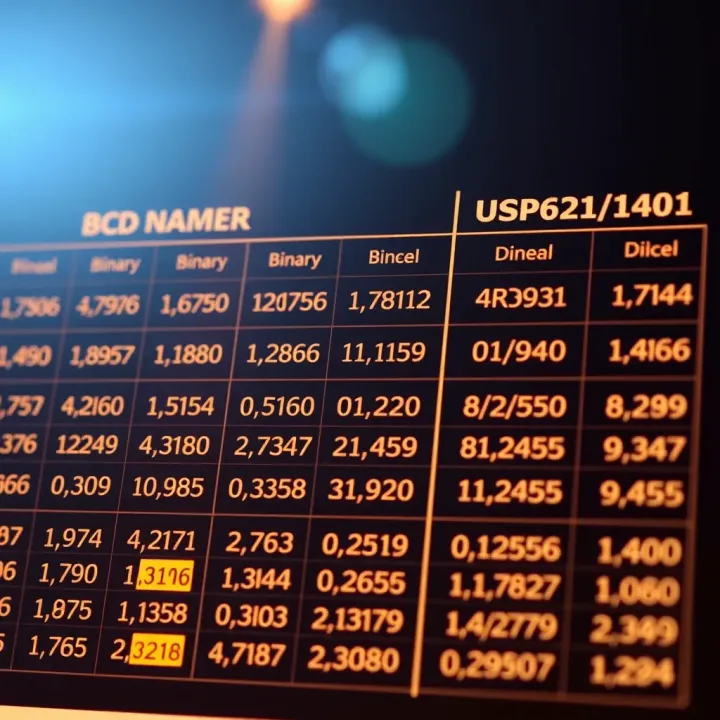
For instance, a common mistake in pure binary arithmetic is seen in financial calculations where ₦125 might convert to binary as a single number, potentially introducing small errors when converting back. BCD avoids this by keeping each digit separate, so ₦125 is encoded as 0001 0010 0101 (1, 2, and 5 respectively). This precise encoding supports reliable manual and automated digit processing in calculators and ledgers.
To put it simply, take the number 4729. In BCD, this number is represented as:
4 → 0100
7 → 0111
2 → 0010
9 → 1001
Together, it reads as 0100 0111 0010 1001. Notice how every decimal digit remains distinct within the binary sequence. This contrasts with standard binary, where 4729 as a whole would convert to 1001001111001, losing individual digit identity.
BCD also finds use in packed and unpacked formats in computing. Packed BCD stores two decimal digits in one byte, making it more space-efficient—a useful feature in embedded systems and financial applications with space limits. Unpacked BCD, in contrast, stores each digit in a separate byte, often simplifying processing at the cost of memory.
Using BCD ensures accuracy and clarity when handling numbers that require exact decimal representation, such as prices, interest rates, and stock quantities.
In the Nigerian marketplace, where small errors in calculations can lead to significant financial discrepancies, BCD's way of encoding digits supports trustworthy digital financial systems. This is why several fintech platforms and accounting software commonly depend on BCD for handling decimal values.
Binary Coded Decimal (BCD) has several formats tailored for different uses in computing and digital electronics. Understanding these variations helps traders, investors, and students alike grasp how decimal digits are encoded efficiently and why one format might be preferred over another in financial systems or embedded devices.
Packed BCD stores two decimal digits in one byte, with each nibble (half a byte) representing a single decimal digit. For example, the decimal number 29 becomes 0010 1001 in binary—‘0010’ equals 2 and ‘1001’ equals 9. This format saves space compared to unpacked BCD while still allowing easy conversion between decimal and binary.
Packed BCD is handy in devices where memory efficiency matters. Calculators and digital clocks often use it because it reduces storage needs without complicating the processing too much. In financial software, packed BCD is useful because it keeps decimal precision intact, helping avoid rounding errors common in floating-point math.
Unlike packed BCD, unpacked BCD uses one full byte to store every single decimal digit. Each byte holds a value between 0 (0000 0000) and 9 (0000 1001), with the remaining bits usually set to zero or ignored. So, the decimal number 29 in unpacked BCD becomes two bytes: 0000 0010 for the '2' and 0000 1001 for the '9'.
While unpacked BCD wastes more memory, the trade-off is easier data manipulation. Microcontrollers, especially those in embedded systems common in Nigeria's manufacturing or automotive industries, often prefer this because each digit can be accessed and processed independently without bit-shifting.
Beyond packed and unpacked formats, there are other BCD variations designed for specific tasks. For example, the Excess-3 code adds 3 to each decimal digit before encoding, which simplifies certain arithmetic operations. It sees use in error detection and digital systems where minimal hardware logic is desired.
Another example is the Densely Packed Decimal (DPD) format, which compresses three decimal digits into ten bits rather than twelve, improving storage efficiency in large data systems. However, DPD needs more complex decoding, so it's mainly found in specialised hardware or enterprise-level financial computing where large volumes of decimal data demand high efficiency.
Understanding these variations gives you insight into not just how decimal numbers become binary but why certain methods suit particular use cases better, especially in Nigeria’s growing tech and finance sectors.
Binary Coded Decimal (BCD) finds frequent use across everyday devices and specialised tech, especially where accurate decimal representation matters. Its role stretches beyond academic discussion into practical systems you may encounter daily or in professional settings.
Digital clocks and calculators rely heavily on BCD to display decimal numbers clearly. Unlike pure binary, BCD encodes each decimal digit separately, which simplifies translating numbers for display screens. For instance, a typical calculator processor converts each digit the user inputs into BCD, avoiding conversion errors that often occur when working directly with binary fractions. This approach ensures the numbers you see—whether the time on a digital wristwatch or a calculation result—are accurate without rounding issues. In Nigeria, where power fluctuations can disrupt complex computations, BCD’s straightforward encoding provides robustness, reducing glitches in such portable devices.
Financial institutions and accounting systems use BCD to maintain decimal precision critical for money calculations. Banks like Access Bank and fintech firms such as Paystack often deal with transactions requiring exact decimal representation to avoid errors that could lead to losses or regulatory issues. BCD encoding prevents rounding discrepancies common to floating-point binary formats, ensuring figures in ledgers, invoices, or balance sheets reflect true values. For example, when calculating interest or taxes, every kobo counts, and BCD supports these precise computations smoothly. This technical choice enhances trust in digital financial operations crucial for Nigeria’s growing cashless economy.
Embedded systems and microcontrollers in devices like fuel dispensers, POS terminals, and home appliances frequently employ BCD for numerical displays and data processing. Microcontrollers programmed to handle user input or sensor readings use BCD to convert decimal data into a binary format that’s easy to process but still human-readable when shown on simple LCD or 7-segment displays. Given Nigeria’s widespread use of POS devices and digital meters, this makes BCD very practical because it simplifies programming and reduces potential conversion errors. Moreover, BCD requires less complex logic circuitry than pure binary arithmetic in some applications, making it cost-effective for manufacturing local embedded devices.
Using BCD ensures decimal accuracy in settings where precision matters most—from your daily calculations to complex financial transactions and embedded sensor systems across Nigerian industry.
In all these applications, BCD acts as a bridge between human-friendly decimal numbers and machine-level binary data. This unique advantage helps maintain accuracy, simplify hardware design, and provide resilience in environments typical in Nigeria, making BCD a quietly essential part of many tech systems around us.
Understanding the pros and cons of Binary Coded Decimal (BCD) is key, especially for traders, investors, and finance analysts who deal frequently with precise numerical data. BCD offers specific benefits by encoding decimal digits individually, but it also comes with limitations that can affect performance and storage. Examining these aspects reveals why BCD still matters in sectors like finance and embedded systems despite some drawbacks.
BCD encoding shines in applications where exact decimal representation is essential. For instance, in financial calculations such as banking or stock trading platforms, using BCD helps avoid rounding errors common in pure binary systems. Each digit corresponds directly to its decimal form, making it easier to convert between human-readable numbers and machine data without approximation.
This accuracy is especially valuable in Nigeria’s growing fintech space, where platforms like Paystack and Flutterwave process transactions demanding exact values. Imagine converting ₦1,250.75 into binary; pure binary might introduce slight inaccuracies due to floating-point representation, but BCD maintains the exact number, safeguarding transaction integrity.
Also, BCD simplifies operations like decimal addition and subtraction because hardware or software can process each decimal digit separately. For calculators or digital clocks often used in schools and offices, this approach keeps things straightforward and reduces errors in display or computation.
Despite its advantages, BCD requires more storage space than pure binary. Since it uses four bits to represent just one decimal digit, storage and processing can be less efficient. For example, while the number 100 requires only 7 bits in binary, it needs 12 bits in BCD (three digits times four bits).
In high-frequency trading or real-time analytics where speed matters, BCD can slow down processing compared to pure binary, which uses space and computation more economically. Complex operations like multiplication or division in BCD also require extra steps, increasing computational overhead.
Moreover, modern computers and processors are optimised for binary arithmetic, so BCD operations may not tap into the full hardware acceleration available. Systems that prioritize performance over exact decimal representation tend to prefer pure binary or floating-point formats.
While BCD ensures decimal accuracy, its increased memory and slower processing speed make it a trade-off. Choosing between BCD and pure binary depends largely on whether precision or efficiency is the priority.
In summary, BCD encoding offers clear benefits in financial accuracy and human-readable output, crucial for many Nigerian contexts. However, its extra memory use and slower computation mean it’s not the best fit for every application, especially where speed and storage are tight. Understanding these points helps users and developers decide how best to handle decimal numbers in technology solutions.
When dealing with numbers in computing or finance, understanding the different ways to represent them is vital. Comparing Binary Coded Decimal (BCD) with other numbering systems like pure binary and hexadecimal helps clarify where BCD fits, especially for people involved in trading, investing, and financial analysis. This comparison highlights practical trade-offs such as ease of conversion, processing efficiency, and accuracy of decimal representation.
Binary represents numbers using only two symbols: 0 and 1, encoding values as powers of two. For example, the decimal number 45 is written as 101101 in binary. BCD, on the other hand, encodes each decimal digit separately in a four-bit binary sequence. So, 45 in BCD becomes 0100 0101, representing 4 and 5 individually.
The key advantage of BCD is its exact representation of decimal digits, which is crucial in financial applications where rounding errors can cause serious problems. Computers using regular binary often encounter tiny inaccuracies converting between binary fractions and decimal fractions due to the base difference. With BCD, each digit is stored exactly, reducing such rounding issues.
However, BCD uses more memory compared to pure binary. For instance, representing the decimal number 99 takes 7 bits in pure binary (1100011) but 8 bits in BCD (1001 1001). This inefficiency can be significant in systems with limited storage or processing power.
Another practical point is that basic arithmetic is faster and simpler in pure binary. Processors are optimised for binary calculations, making operations on binary numbers quicker than BCD. In sectors like stock trading platforms where speed matters, pure binary performs better. Still, many financial calculators and embedded systems use BCD to avoid risks associated with decimal precision loss.
Hexadecimal (base 16) uses sixteen symbols (0-9 and A-F) and is commonly employed in programming and memory addressing because it is more compact than binary. For example, the decimal number 255 converts to FF in hexadecimal and 11111111 in binary.
While BCD works on decimal digits, hexadecimal groups bits into four but represents values from 0 to 15, covering more range per digit than BCD's 0 to 9. This makes hexadecimal more efficient for storing large numbers or addressing memory locations.
However, hexadecimal lacks the one-to-one mapping to decimal digits that BCD provides. This means when you need to display or process numbers as exactly they appear in decimal, BCD simplifies conversion and reduces errors.
For example, in banking software managing currency values, BCD ensures straightforward decimal digit handling, whereas hexadecimal would require additional steps to convert internally stored values to user-friendly decimal form.
In summary, BCD trades storage efficiency and processing speed for precise decimal digit representation, making it a reliable choice in financial and embedded systems. Binary and hexadecimal offer compactness and speed but require extra care to maintain decimal accuracy.
Understanding these differences helps traders, investors, and finance analysts evaluate which numbering system suits their technical and accuracy demands best.
Explore Binary Coded Decimal (BCD) 📊 — understand its basics, types, comparison with other systems, practical uses in digital tech, and common challenges.

📊 Explore how computers use binary code to process, store data, perform arithmetic, and power digital electronics. A clear guide to fundamentals and uses!
🔢 Explore binary calculation basics, from arithmetic and logic operations to converting number systems, essential for everyday tech & computing in Nigeria.

📈 Explore how binary options work and their risks tailored for Nigerian traders. Learn smart strategies, regulation tips, and risk management to trade wisely.
Based on 9 reviews